

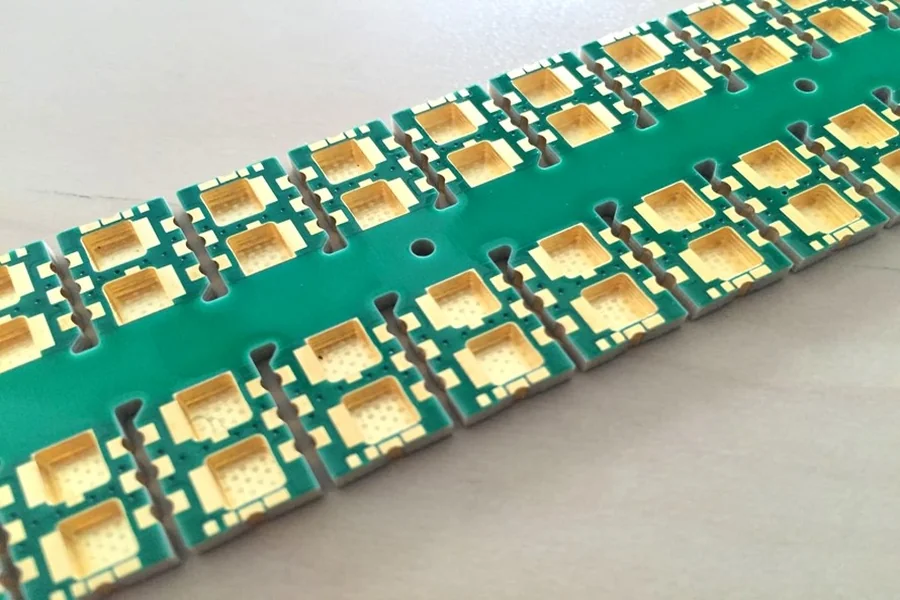
A heavy copper PCB board is a type of printed circuit board that features unusually thick copper layers—generally ranging from 3 oz/ft² to over 10 oz/ft²—compared to the standard 1 oz/ft² copper thickness found in most PCBs. This additional copper thickness enables the board to handle higher currents, dissipate heat more efficiently, and provide enhanced mechanical strength. Heavy copper PCB boards are crucial for industries where high power levels, robust performance, and long-term reliability are non-negotiable.
These boards are extensively used in power electronics, industrial control systems, automotive applications, military electronics, and renewable energy systems. Their ability to withstand extreme electrical and environmental stress makes them a go-to choice for engineers designing mission-critical equipment.
Construction and Features of Heavy Copper PCB Board
The construction of a heavy copper PCB board involves the application of thicker copper foil during the manufacturing process, which is then plated to achieve the desired thickness. This copper layer is bonded to the board’s dielectric substrate and patterned using advanced etching techniques to form conductive traces, pads, and planes.
One of the standout features of heavy copper PCBs is their improved current-carrying capacity. The thicker copper traces can carry significantly more current without overheating, making them ideal for high-power applications. Additionally, the enhanced copper mass improves thermal management, helping to distribute and dissipate heat generated by components or high-current flows.
Another advantage is superior mechanical strength at connector sites and in plated-through holes. This increases the overall durability of the PCB, especially in environments subject to frequent mechanical stress or vibration.
Advantages of Heavy Copper PCB Board
The heavy copper PCB board offers a range of benefits that go beyond standard circuit board designs. Firstly, its high current tolerance makes it suitable for power converters, power distribution systems, and high-current motor controllers. Engineers can design compact boards without worrying about excessive heating or voltage drops.
Secondly, the increased copper thickness enhances heat dissipation. This is particularly important for applications such as automotive braking systems, military power supplies, and renewable energy inverters, where thermal stability directly affects performance and safety.
Thirdly, heavy copper boards allow for reduced circuit complexity. Designers can integrate high-current and control circuits on the same board without needing additional heat sinks, cables, or connectors. This reduces assembly time, improves reliability, and can lower overall system cost.
Finally, heavy copper PCBs exhibit excellent durability. They can withstand repeated thermal cycling, extreme temperatures, and aggressive operating conditions without significant degradation.
Applications of Heavy Copper PCB Board
The applications of heavy copper PCB boards span across industries where power handling and durability are critical. In power electronics, they are used in power supplies, DC-DC converters, and UPS systems.
In the automotive sector, heavy copper PCBs are integral to electric vehicle battery management systems, charging stations, and high-performance braking systems. Their robust nature ensures they function reliably even under high-vibration and high-temperature conditions.
Military and aerospace applications also rely on heavy copper boards for mission-critical power distribution and control circuits. These environments demand unmatched reliability, and heavy copper boards deliver that through exceptional mechanical and thermal resilience.
In the renewable energy sector, they are essential for solar panel inverters, wind turbine controllers, and energy storage systems. Their ability to handle high currents while dissipating heat efficiently ensures long-term stable operation, even under continuous high-load conditions.
Manufacturing Process of Heavy Copper PCB Board
The process of manufacturing a heavy copper PCB board begins with the selection of a high-quality substrate material, typically FR4 or a high-temperature laminate, capable of supporting the thick copper layer.
Copper foils thicker than standard are laminated to the base material, and additional plating is applied to reach the desired final copper thickness. This is followed by precision photoresist imaging and etching to create the circuit pattern. Due to the increased copper thickness, etching must be carefully controlled to ensure trace definition and prevent over-etching.
Plated-through holes and vias require additional attention, as the thick copper increases plating requirements and demands uniform coverage for electrical reliability. After pattern formation, the board undergoes solder mask application, surface finishing, and rigorous electrical and thermal testing to verify performance under load.
Future Outlook for Heavy Copper PCB Board Technology
With the increasing demand for high-power and high-reliability electronics, the heavy copper PCB board market is expected to grow significantly. Emerging sectors such as electric vehicles, smart grids, and industrial automation will drive innovation in heavy copper board manufacturing, pushing for even better thermal performance, miniaturization, and multi-layer integration.
Advancements in additive manufacturing and improved plating technologies may soon allow even more precise control over copper thickness, enabling complex 3D circuit geometries for next-generation power systems.
Choosing the Right Heavy Copper PCB Board Manufacturer
When sourcing heavy copper boards, selecting the right heavy copper PCB board manufacturer is critical to achieving the best performance for your project. An experienced manufacturer should have advanced plating and etching capabilities, the ability to work with various copper thicknesses, and proven expertise in thermal management and mechanical reinforcement. They should also provide strict quality assurance, from raw material inspection to final testing, to ensure every board meets or exceeds your operational requirements. Partnering with a reliable heavy copper PCB board manufacturer ensures that your high-current, high-power designs are built to last and deliver consistent performance even in the most demanding environments.
